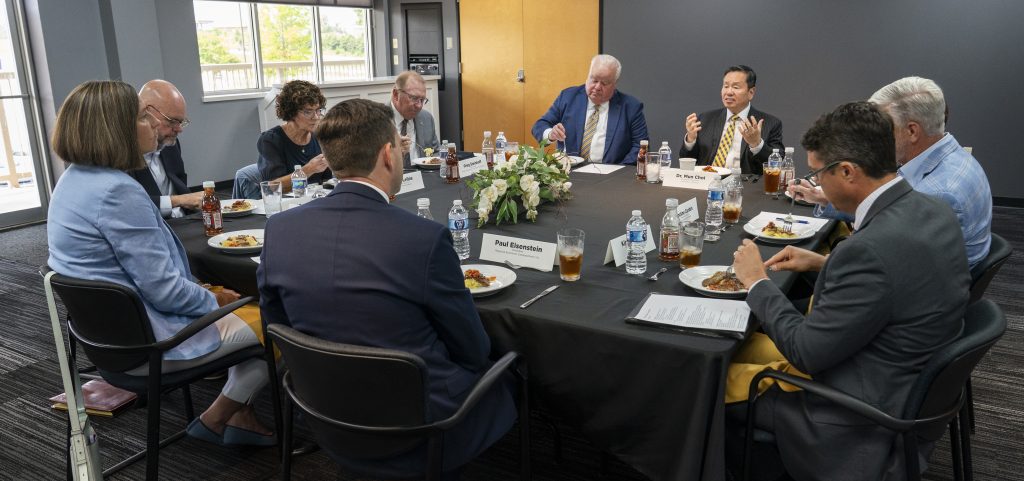
Several of Columbia’s local leaders and entrepreneurs met with one thing in mind: the city’s future. Specifically, the economic future.
The past few years have been a restless time for the city. Among infrastructure changes, repeated safety concerns raised, and businesses coming and leaving, predictions for Columbia’s future are in constant limbo. Some Columbians want greater investment from leadership, some want new leadership and some want us to remain in place, maintaining the status quo. Inside Columbia magazine publisher emeritus Fred Parry spoke with a table of guests over a meal from chef Jeff Guin of The Broadway hotel to discuss our city’s recent highlights, concerns and needs relating to future economic longevity.
Initial Thoughts
First, the group weighed in on changes that are brightening Columbia’s future: the airport’s expansion, anticipation for the NextGen MURR project, public and private sector growth, and the university were named as major positives.
The recent expansion of the Columbia Regional Airport — new flights, a shuttle service and the added terminal in 2024 — was lauded by the group as a gamechanger for Columbia. This is fresh off of the airport’s busiest summer yet, with a record 19,584 passengers departing in June (as opposed to the 9,294 in June 2025). Roundtable guests agreed that the airport shows promising growth for Columbia. Then Dr. Mun Choi, president and chancellor of the University of Missouri, spoke on NextGen MURR as another highlight.
NextGen MURR is a 20-megawatt, state-of-the-art reactor built to expand both research and production of cancer treatment and theranostics. The current 10-megawatt MU Research Reactor (MURR) is already internationally recognized for its innovation in isotope production; NextGen will build upon that success, making Columbia a hub for nuclear medicine in the United States. Choi says the reactor will draw in both business and revenue from the pharmaceutical field.
“It’s not just about building a nuclear research reactor, but about creating an ecosystem in this region for nuclear medicine,” Choi says. “Our vision is to have an ecosystem that works with innovative companies that have great ideas but need access to a reactor and capital. We believe that with the current reactor, 10 years from now, we can reach up to half a billion dollars in reactor revenue. That’s not even considering the small company start-ups that will add to economic development.”
With the forecasted influx of attention from the pharmaceutical industry in Columbia, Choi still questions if the city is beyond its current infrastructure. “I wonder if we have outgrown the type of city government we have,” he adds. “Are we ready to grow economically? Do we have the right structures?”
As the group contemplated this, they reached an agreement that in order for Columbia to achieve sustainable growth, attention should be paid to the business community, especially from leadership.
“Having a strong local government, one that is responsive and supportive of the private sector, is extremely important,” Greg Steinhoff, president of M H Farms, Inc., says. He adds that in order for the local economy to thrive, leadership needs to make a space that attracts business, whether that be through infrastructure changes, housing or legislature. “When time and attention is paid to (business), great things can happen. On top of that, we need our city to look good, feel good, be good and provide services.”
A city that looks good, feels good and provides services is one that has excellent quality of place. This is a term Parry says he’s seen become a major focus in Springfield, Mo. Quality of place — the collection of traits that make a community an ideal destination to live, work and visit — includes opportunities for business growth, plentiful housing, public safety and cohesive leadership.
How can Columbia improve its quality of place? Heather Hargrove, clinic development director at Liberty Family Medicine, chimes in. “To focus on the quality of place, we need to think about what we already do well and what investments can be made to expand that,” she says. “Instead of trying to make (Columbia) something it isn’t, investments should be made in what we do well. How do we continue to improve upon that for the community? It’s about quality versus quantity.”
As discussed earlier, Columbia thrives in several promising areas: the airport, NextGen MURR, the flagship university and the business community. Quality of place improves once investments are made in these areas.

University Success
Without a doubt, the University of Missouri drives the lion’s (or tiger’s) share of the local economy.
Football season is our bread and butter, compounded with back-to-school traction. When students return to the university, hotels are booked, new flights at COU are taken advantage of, reservations are made at restaurants and local businesses see a boost in shoppers. The athletics factor will be discussed later, but for a moment, the group ruminated on the importance of students to the economy. How can the city better support the university as an economic force and create an environment where students want to stay after graduation? Choi stresses the importance of students receiving advanced degrees from MU and contributing to the flagship university, an R1 research institution.
“Many of our top students graduate and want to find a job quickly,” Choi says. “They don’t want to take on another four or five years for their Ph.D. because, in their minds, they can’t take on another loan. They don’t realize that for programs in science and engineering, they can get paid to pursue their Ph.D. We’re changing the perspective among undergraduate students and encouraging research with faculty so they are prepared to pursue their Ph.D.”
For students not continuing education at the university, Columbia needs to be a viable option for post-graduate working and living. Rockne Corbin, president and CEO of Shelter Insurance Companies, says making room for a young workforce is key to Columbia’s success.
“We are fortunate to have a large number of bright, young people who are here,” Corbin says. “I think it’s a matter of creating an environment that allows these young employees to flourish and stay here.”
But to retain recent graduates in the local workforce, Columbia needs to support its business community.
Business
Veterans United, EquipmentShare and Shelter Insurance were among the companies praised at the luncheon for their contributions to both the local workforce as well as bringing in talent, and their offerings to the local economy.
Paul Eisenstein, president of REDI, says making Columbia a place where new graduates of the university want to stay is paramount to the future. “I’d like to see more (businesses like Shelter Insurance),” he says. “More EquipmentShares. More VUs. I think of how many startup companies Columbia can have. People who come with their own ideas and bring prosperity.”
But in order to do so, Columbia needs structures in place to let business thrive. “Retaining our young people who are already here is key,” Eisenstein adds. “We need to be strategic — we need more companies, more jobs. There’s tremendous opportunity out there with both the skilled trades and white- collar work.”
But the concern stretches beyond job opportunity; a lack of comprehensive infrastructure planning and limited housing options have historically hindered some of Columbia’s workforce retention.
Kip Kendrick, the presiding commissioner of the Boone County Commission, was bullish on the Improve I-70 project and NextGen as beneficial for both the city and county as a whole, and hopeful that these projects will help retain the workforce — if infrastructure keeps up.
“As long as infrastructure growth happens, commercial, residential and industrial growth will follow as a result,” Kendrick says. “NextGen MURR is the most transformative project we will have this century. It’ll be critical to make sure this is a place for growth.”

Housing and Infrastructure
On housing, Alice Leeper, president of the Columbia Board of Realtors, says it is a multi- dimensional issue. Rent is too high, which says Columbia doesn’t have enough rental stock. Rent is elastic in ways house prices are not: rent costs fluctuate. There is a notable lack of middle housing for those looking for something between a single-family home and a large apartment complex. There is a need for flexibility in what types of homes can be built in certain areas to allow for that missing middle housing. Leeper says this calls for not only a change in city ordinances, but a change in mindset. “Higher density does not have to be unattractive,” she says. “It’s not a bad idea to integrate higher-density into some of our single family neighborhoods to try and alleviate the strain on housing.”
From a government standpoint, Kendrick says zero-lot-line ordinances may amend the housing shortage. He cites a recent zero-lot-line development in a subdivision as successful and says thinking of new solutions, such as connected zero-lot-line housing, is key. “There’s a lot of innovation in the housing space right now,” Kendrick says. “How can we stay flexible to these ideas and create more predictability in the housing market?”
Columbia residents have seen a lack of predictability not only with the market, but with local government as well. Bureaucracy and red tape also contribute to the housing problem. “The city has to figure out how to fill these lots in the first ward,” Mike Murphy, ComoBuz publisher and seasoned journalist, says. “But they’ll have to upzone, which is politically difficult, and they have infrastructure problems on their hands.”
So what does predictability look like? Kendrick says, “I see it as local government moving more decisions from a discretionary view to an administrative view in order to cut down the long processes of planning, zoning and getting approvals. Political winds can change very quickly on developments that have been planned out for years. There needs to be more predictability, a checking of power and black-and-white, clear standards on the administrative review process.”

Public Safety
While housing and infrastructure concerns were voiced, the group agreed that safety in downtown Columbia was in great need of improvement. The topic shifted to a refreshing, honest discussion of where our city is falling behind and what can be done.
Over the years, downtown has shifted. The mom-and-pop shops seem to be growing sparse, the homeless population is prominent, there’s a high turnover of business tenants and some Columbians report simply not feeling safe downtown anymore. How can downtown remain a place people still want to work, live and go out — and just how important is downtown to the city’s success?
Murphy says a robust, dynamic downtown is key. “Downtown is critical,” he says. “I can’t imagine thinking otherwise. There’s a lot of room for development, even for a phenomenal entertainment district … but that vision is just idle talk if we ignore the elephant in the room, which is public safety.”
Downtown safety has been a pertinent topic among city officials and university leadership for several years now. With this area being such a strong draw for students and tourism, what measures should be taken to ensure public safety? When we envision our ideal downtown Columbia, what do we see?
Choi cites similar cities such as Ann Arbor, Mich. and Austin, Texas as examples of bustling university downtowns. Higher-end hotels, dining options and shops should take up residence downtown to draw in students and families.
Sports tourism is obviously a massive draw for Columbia. But we need areas for families to dine, gather and enjoy themselves safely, beyond Memorial Stadium. Downtown needs to compliment sports tourism.
“Sports tourism is a vital asset,” Hargrove agrees. “Families are making investments in that. It’s their weekend vacation. They want to go to a game and explore downtown. We need to take advantage of what Columbia has to offer and expand upon that.”
Leeper mentions that with MU being so close to downtown, how the area appears to prospective students and families is vital not only to enrollment, but also to perception of our city as a whole. “We live and die by how the university does,” she says. “So with downtown, we should have a vision for an area that is in support of parents coming to see their kids and stay for a game … it helps recruit students and families when downtown is a more exciting, dynamic place.”
Local Silos and Leadership
Beyond concerns regarding downtown, the group identified the root of Columbia’s struggles — a disconnect between various silos in the city and county, an overall lack of vision and inconsistent leadership.
“No matter what topic we discuss, the absolute foundation and basis is leadership,” Hargrove says. “Within the business community, there needs to be some resiliency and working together as leaders, not just one person. A group.”
Uniting on one vision has proven difficult for Columbia — the group identified three major silos that have kept the region stagnant for their lack of collaboration: the university, the city and the county. Other silos could include the business community and the health care industry. These silos work individually, not collaborating when collaboration is key to a united vision for Columbia.
As the group discussed ways to encourage collaboration, Kendrick was praised for his work as county commissioner, adamant about improving communication, especially in infrastructure. “How do we get around that?” he asks. “More meetings, more decisions, more difficult conversations. When we get new people into these government positions, there’s more potential for people to strategically align and coordinate moving forward.”
Hargrove adds that the key will be breaking down the silos. “If we don’t get complacent and we really get aligned, we’ll be in good shape,” she says. “I believe Columbia is well-positioned to be in good shape, but now is the time to act.”
Proposed Solutions
Unity is the future. There should be solidarity among the business community, the university and local government to build a vision. Steinhoff commends Choi for voicing his concerns with the city, but said the chancellor should have had more backing from the business community.
“It shouldn’t just be one person who goes out alone,” Steinhoff says. “We need an influential team of people who develop their collective concerns rather than sending someone out on a limb by themselves.”
But who leads? The group identified the need for an effective leader to take initiative — someone who is held accountable across the city and county, prioritizes quality of place and develops a clear vision.
Eisenstein suggested that the Chamber of Commerce should be a part of the leadership that develops a vision for Columbia’s growth. The new Chamber CEO, Abdul-Kaba Abdullah, was mentioned as a bright point for the Chamber with hopes that he can be more strategic and a larger force in the city.
“How can we rally around the Chamber?” Eisenstein asks. “They bring the business perspective on public safety and housing. They need to take the lead on (these issues) or certainly be a part of the conversation.”
On the topic of business, Choi acknowledges the success of Columbia’s companies, while asking what can be done to allow for more business. “EquipmentShare, Veterans United, Solventum, American Outdoor Brands and many others have been successful,” Choi says. “What I would like to learn from these businesses is: How difficult was it to achieve those successes? What are the barriers we want to remove?”
Overall, the group was optimistic. While there is a lack of collaboration from silos, as well as rising concern for public safety and housing, Columbia has several positives to build from. The business community is doing well, the airport is growing, the university is thriving and projects like NextGen MURR are promising. Columbia is like an old house in need of a renovation; the foundation is good and the bones are strong.
All That’s Missing is a Vision
Such a vision takes initiative, leadership and growth — some of which may be uncomfortable. Much like the construction on I-70, change takes tremendous effort and comes at a cost. Is Columbia prepared to make such a change? Is Columbia prepared to take on growing pains and collaborate on a vision, to break down those silos and unite?
“Some are more concerned about keeping the status quo rather than suffering the pain that may come along with growth,” Leeper says. “While we have a bunch of individual ideas, nobody has crafted the vision of what Columbia could be. You don’t get big ideas until you have a place where big ideas can grow.”
Rapid Fire Final Thoughts
“I would like city council members to focus on public safety and think not only about the welfare of their ward but also about the entire city and county as a whole.” — Dr. Mun Choi, University of Missouri
“We can’t have ‘not in my neighborhood-s,’ especially with housing.” — Alice Leeper, Columbia Board of Realtors
“The biggest thing at this time is talent recruitment and keeping talent in Columbia’s workforce.” — Rockne Corbin, Shelter Insurance
“Long-term, our footprint here in mid-Missouri needs to continue to grow. It’s critical to maintain growth and continue attracting people to live here, which all comes back to housing.” — Kip Kendrick, Boone County Commissioner
“We are one of a few central Missouri communities that is growing. We’re home to a flagship university, well-connected with the airport and I-70. We cannot take this growth for granted.” — Paul Eisenstein, REDI
“How do we build leadership that reduces friction and builds on the active success we have here? We need to expand and build on these successes without becoming complacent.” — Heather Hargrove, Liberty Family Medicine
“We need to be careful about not regaining some confidence in the city government. And to be very careful about continuing to flounder any further from the increasing lack of confidence that will spin off from that.” — Mike Murphy, ComoBuz.com
“Public safety, to me, is the number one thing that needs to be addressed.” — Carla Leible, Zimmer Communications
“Columbia is well-positioned for similar elevation and growth like the transformation we’ve seen in Kansas City.” — Greg Steinhoff, M H Farms, Inc.