

Photos by L.G. Patterson and contributed by MU Athletics
Opened on October 2, 1926, heavy rains turned the field of Memorial Stadium into a mud pit as the Tigers played against Tulane, ending the game in a 0-0 tie. Since then, the stadium has witnessed its share of history and traditions, including big upsets, Homecoming coronations and waves of freshmen taking part in “Kiss the 50.” This year, in addition to trying to fit 100 candles on a birthday cake, Memorial Stadium will complete its Centennial Project, opening a completely renovated north end zone and an update of the rest of the concourse. A century’s worth of football games, historic moments and cherished memories live in the heart of Columbia, where the University of Missouri’s Memorial Stadium has stood for 100 years. With each decade came new significance — from increased seating to broken records. Let’s take a trip through Memorial Stadium’s timeline.
The History of Memorial Stadium
1920s
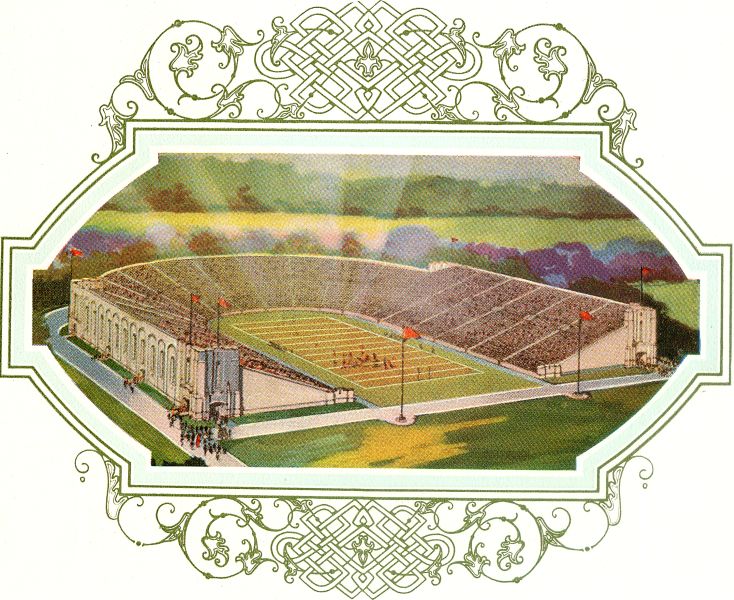
In December of 1925, a sizable valley was carved between twin bluffs south of campus. This ground-breaking led to what Mizzou fans know and love as Memorial Stadium, dedicated in memory of the 112 Missouri graduates and students who died in World War I during the 1926 season. The following year brought the cherished rock “M,” after members of the freshman class constructed it with rocks left over from the stadium project. Standing 90 feet wide by 95 feet high, this landmark has witnessed Mizzou magic ever since.

1930s
Making his debut as head coach in 1935, Don Faurot led the Tigers to a 39-0 win over William Jewell College. Three years later, the Tigers would begin a 20-game winning streak at Memorial Stadium — a record that stands today. In November of 1939, Mizzou, as an unranked team, defeated #10 Nebraska (their first win over a ranked team in program history). The Tigers would go on to win the Big Six title that season, the first of three league championships under Faurot’s tenure as head coach.
1940s
By 1949, Memorial Stadium had seen over two decades of Tiger football, and it was time for an upgrade. This expansion added 5,000 seats to the west stands, increasing the number of rows from 40 to 78. A new press box was also built, with capacity for 50 writers and eight radio booths.

1950s
The night before the Missouri-Nebraska game in October 1957, a group of pranksters changed the rock “M” to an “N.” The Mizzou groundskeeper — with the help of some young men who gained free admission to the game — restored the “M” to its proper form before kickoff. A last- minute touchdown secured a win over the Huskers.
1960s
The 60s kicked off with one of the most infamous events in the history of Memorial Stadium. The #1-ranked and undefeated Tigers were upset by rival Kansas, spoiling hopes of a national championship. However, it was later discovered that Kansas had used an ineligible player and the game was later forfeited by the Jayhawks, giving Mizzou a bittersweet administrative victory. In the summer of 1965, the final expansion of the original horseshoe was completed on the southeast corner, adding 3,595 seats.

1970s
In 1972, the playing surface at Memorial Stadium was named Faurot Field, in honor of legendary coach and athletic director Don Faurot. That season, coach Al Onofrio’s unranked Tigers upset #7 Colorado; over the next four years, Onofrio would lead Mizzou to five more upsets on the newly christened Faurot Field. This includes one of the biggest wins at Memorial Stadium when the #12-ranked Tigers defeated #2 Nebraska — a last-minute two-point conversion attempt by the Huskers was intercepted by MU’s Tony Gillick. A long history for the Tigers, Nebraska had beaten Mizzou by a combined score of 98-0 the two previous years, the highest ranked foe any Tiger team has ever beaten. To close out this decade, the south endzone was enclosed with 10,800 seats.
1980s
In a game against Penn State on Oct. 4, 1980, Memorial Stadium held its largest crowd to date — 75,298 fans witnessed this game. In the summer of 1984, the glass-enclosed Tiger Lounge was constructed in the lower level of the press box facility. The following year, Faurot Field was converted from natural grass to artificial Omniturf. That season closed 0-7 at home, but the following year brought a school record by Tom Whelihan: a 62-yard field goal.

1990s
Despite improvements over the years, the Big Eight Conference coaches made a statement citing that “the football field at the University of Missouri is a detriment to the home and visiting teams and takes away from the integrity of the game played on such a field.” This spurred a major renovation in 1992, where facilities were completed under the south stands to give the Tigers a spacious locker room, better medical facilities and an interview room. The following month, coach Bob Stull’s Tigers closed the season with a 22-17 upset win over Kansas, where Jeff Jacke set an MU single-game record by making five field goals in the game.


In September 1994, The Rolling Stones performed an open-air concert at Memorial Stadium, providing nearly $100,000 toward the eventual project that converted the Omniturf surface back to natural grass the following year. Faurot, who helped lay sod for the original field in 1926, put down the final piece of sod to finalize the new field. The next year, four light towers were permanently installed, giving Missouri the opportunity to host night games on a regular basis.
A few years later, a $12 million project replaced restrooms, concession stands and concourse surfaces beneath the grandstand. This renovation also included a new video replay board, new ticket booths, a reconfigured north entrance, more brickwork to accent the stadium and parking lot improvements.
2000s
The Faurot Field sod was torn up in 2003, transitioning to another artificial surface, FieldTurf. The first game played on FieldTurf was a success, Mizzou coming out on top of Eastern Illinois 37-0 — the Tigers’ first shutout win since 1998. This didn’t last long though, after an unexpected loss at Kansas. However, in Mizzou fashion, the Tigers rebounded to earn one of their biggest wins in recent memory, upsetting Nebraska 41-24 during a nationally televised game on TBS. The win, which came before a sellout crowd of over 68,000 fans, broke the 25-game Husker winning streak over MU, marking Mizzou’s first win in Columbia over Nebraska since 1973. That same season, Mizzou became bowl eligible after beating Texas Tech in a game where QB extraordinaire Brad Smith broke a record by scoring five touchdowns as he rushed for 291 yards. Smith closed out his career at Memorial Stadium — holding 69 different MU, Big 12 and NCAA game, season and career records — by leading the Tigers to a 31-16 win over Baylor.

In 2006, then-sophomore Chase Daniel made his first career start, promptly breaking the MU single-game passing touchdown record by throwing five scoring strikes in the 2006 season opener against Murray State. The following season, the 17th-ranked Tigers blitzed the #25 Nebraska team before a modern-day record crowd of 70,049 — marked MU’s most lopsided win over Nebraska since 1947. The following season, the Tigers would see a brief but memorable stint as a #1-ranked team in the AP Poll.
2010s
In 2010, Mizzou earned their first win over a #1-ranked opponent, the Tigers posting a 36-27 comeback victory over Oklahoma for Homecoming. This was also the first Columbia appearance by the ESPN College GameDay set. By the following year, the University of Missouri was unanimously voted into the Southeastern Conference, effective July 2012, as the 14th institution in the conference. Mizzou played its first SEC game against the Georgia Bulldogs at Faurot Field, with commissioner Mike Slive on hand for the ceremonial coin toss for the historic occasion. The following two seasons, the Tigers closed out with a record of 7-1 against SEC opponents and were SEC East champions.


Enter the North End Zone
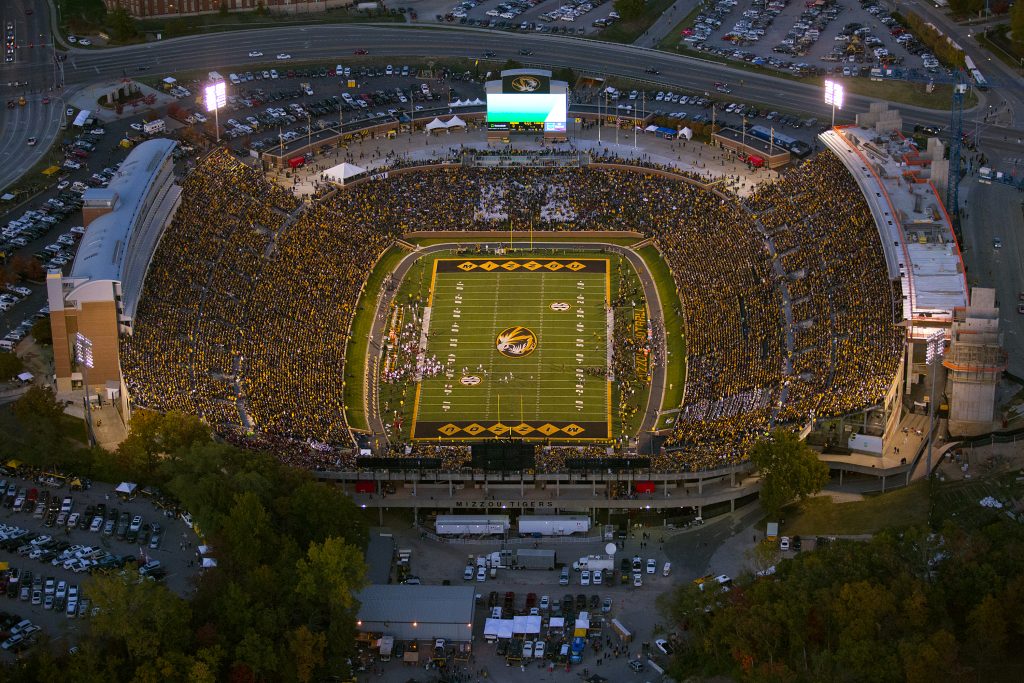
The biggest renovation of Memorial Stadium to date is the Centennial Project, which includes a complete remodel of the north end zone. For the past two years, Columbia residents and football fans have witnessed the progression from turning what used to be an open concourse and grassy hill into an enclosed structure with brick siding, premium suites and an updated video screen facing the road.
Throughout the last football season, game attendees navigated the stadium through different entrances and saw construction crews on the display board between plays. At times, it felt like the stadium renovations may never be completed, and this “under construction” status would go on. But just in time for Memorial Stadium’s 100th season, the Centennial Project is now complete.

Dave Matter, the senior associate athletics director for strategic communications and media, says reaching this milestone at this specific time is massive. “All of that credit goes to our university leaders and Board of Curators,” he says. “The stadium has been through many iterations over the years, but this is the biggest. It gives the entire footprint a completely new look and feel.”
This $250 million project, headed by Whiting-Turner, comes with 160,500 square feet of new construction, including 14 field- level open-air suites, two new club sections, loge seating options, mezzanine club luxury outdoor seats and more. These improvements bring the permanent seating capacity to approximately 65,000, and keeps Mizzou on par with some of the grandest stadiums in college football. “The aesthetics are completely different,” Matter says. “It just looks more appealing everywhere: on the field, in the crowd and driving past it.” In addition to added premium seating — which helps to increase revenue for the football program, the athletics department and the university as a whole — the closed stadium will enhance the sound quality, “unlike anything anyone has ever experienced,” according to Matter.

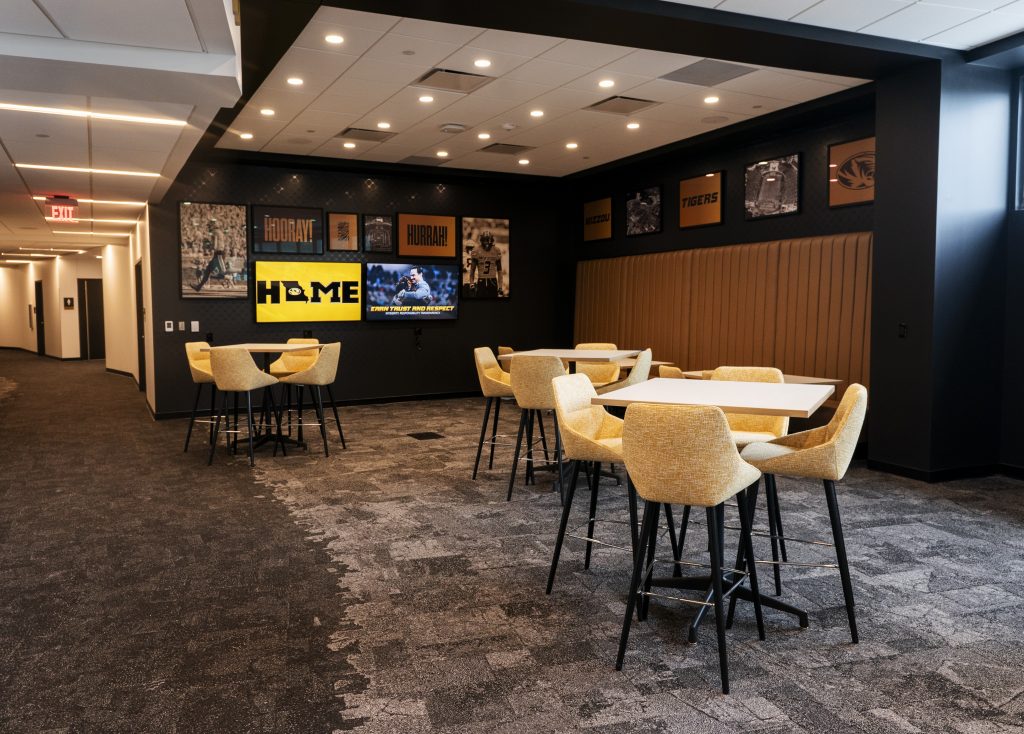
For fans that may not be in the north end zone, fear not. The fan experience as a whole has been elevated, with new concessions, updated bathrooms, new lighting, fresh paint, a new team store, and new imagery and branding across the east and west concourses. “The whole stadium experience basically just got a huge new coat of paint … it’s pretty incredible,” Matter says.
Throughout the entire construction process, one question has remained top of mind for Tiger fans: what’s happening with the rock “M”? Well, it’s not going anywhere. Before a shovel was ever put into the ground to begin this renovation, the athletics program and Board of Curators knew it was important to preserve the history and traditions of the university and Memorial Stadium. “Our fans are very passionate about those things, and we understand that,” Matter says. “You can preserve your traditions without being traditional. We’re finding new ways to celebrate the past and preserve the history of this stadium and program while being innovative.” This includes the decision from day one that the rock “M” would return. The rocks have been stored away during construction, so the same rocks from stadium construction 100 years ago that have been painted by freshmen each year will continue to be part of each home game. “The rock ‘M’ is unique, no other school has it,” Matter says. “It’ll look a little different but we want the experience to be the same.”
One of the overarching themes of this renovation has been giving the university a stadium that keeps up with the SEC. Since joining the Southeastern Conference 14 years ago, Mizzou has made efforts to upscale the facilities, such as by renovating the south end zone to be able to house the football program completely at the stadium in 2019. But with the Centennial Project, Mizzou can now compete in the ambitious environment of intercollegiate athletics and higher education. “We are investing in Memorial Stadium to elevate Mizzou’s national brand and deliver a world-class facility that creates year-round connections for Tiger Nation within the campus, the community and the state of Missouri,” Robin Wenneker, former UM Board of Curators chair, says. “We want to be pace setters and establish the new standard for success.”
Matter takes a note from legendary coach Gary Pinkel: “If you’re going to join the SEC, you need to see cranes all the time,” meaning that improvements are constantly being made to elevate the institution, the program and more. Done and done.
The most common criticism of Memorial Stadium’s ability to “belong” in the SEC is that of seating capacity. While the updated stadium can’t quite match that of Texas A&M or Tennessee (both holding over 100,00 spectators), Mizzou is given credit for its crowd noise, campus aesthetics, traditions, tailgating experience and overall atmosphere. The SEC typically boasts top-tier talent, heavy viewership, regular appearances in the College Football Playoffs and a massive pool of NFL Draft prospects. That being said, the stadium needs to reflect this not just for fans and broadcasting purposes, but from a recruitment standpoint. “As a football program, we are a window to the university, but we’re also a window to our state,” head football coach Eliah Drinkwitz says. “Now we want to continue to represent this state with the best in class. We want to make sure that this project is an opportunity to do that. It’s a big dream … a bold investment. And it’s going to take every single one of us to deliver on it.”
If athletics acts as the front porch of a university, Mizzou has a grander front porch than ever before — you literally cannot miss it at the intersection of Providence and Stadium. “For anyone that’s coming to Mizzou … a prospective student, an athlete, whoever … this makes a big statement,” Matter says. “This takes our program to the next level. We go into the season on a 20-game sell-out streak, and we’re aiming to continue that. fan experience. “I hope the fans recognize the scope and magnitude of what we’ve done to enhance the experience, while also preserving the history, traditions and uniqueness of the university,” Matter says. “Football isn’t just a game, it’s a show; a memorable, magical experience you can’t wait to come back to.” There’s never been a better time to bring recruits than this season because of the stadium, the games, the atmosphere, everything.” On the biggest stage for college athletics, Mizzou is bringing its A-game.
When fans and visiting teams walk into the stadium for the first time this fall, they will be met with a gameday experience unlike what they’ve had before. From the venue to the coaches and players, Memorial Stadium is set to offer a perfect fan experience. “I hope the fans recognize the scope and magnitude of what we’ve done to enhance the experience, while also preserving the history, traditions and uniqueness of the university,” Matter says. “Football isn’t just a game, it’s a show; a memorable, magical experience you can’t wait to come back to.”

As Memorial Stadium celebrates its 100th anniversary and enters its second century, the goal remains to provide lasting experiences to anyone who enters the gates at Faurot Field. “Every year, some of the players or coaches are different, but we still want to produce those great memories and experiences,” Matter says. “Our job is to continue to elevate that, but keep the traditions the same.”
With that, let’s kick off a monumental year of first downs, field goals and victory fireworks. M-I-Z!
Moneyball
It’s no secret that football equals money. From fans making purchases within the confines of the stadium to frequenting local businesses, college athletics bring in between eight and nine-figure numbers to college towns — that’s millions of dollars that help fund a town that is more heavily populated nine months out of the year. So how does our beloved Columbia fare? Across the board, Mizzou Athletics brings in not just visitors, but fans who want the whole gameday experience. And the program doesn’t forget that. “When you talk about having seven or eight home games in a season, those weekend opportunities are huge for our local business economy … hotels, restaurants, shops … it’s massive,” Matter says. “We don’t take that for granted and we have great partnerships all across town. It’s a great responsibility that we take pride in to provide a platform for the university and the city to succeed.”
Stadium Legends
After 100 years, Memorial Stadium is bound to have lore. Some of those stories are a little … out there.
When construction began in 1925, crews had to carve the stadium into a valley between two limestone bluffs. Columbia’s bedrock is notoriously hard, so workers used blasting tools and heavy equipment to excavate the site. Legend has it that during initial blasting, a rock crusher and a truck were trapped. Rather than spend the effort and money to recover them, workers allegedly buried the equipment and continued to build over them. There has been no official dismissal of this claim, so who knows? Maybe there really is some heavy construction machinery beneath our cherished Faurot Field.
Another fabled story, the North End Zone Curse. While it’s likely more folklore than fact, this is a decades-long phenomenon believed by many a fan. With an uncanny number of heartbreak moments (missed field goals, goal-line stands that went against Missouri, costly interceptions, fumbles at the goal line and opposing teams pulling off d amatic plays when Mizzou was driving toward the north end zone), it seems that the only explanation is that the north end zone is cursed, right? Perhaps the Centennial Project renovation will act as the ultimate exorcism of the curse. We’ll find out this season.