
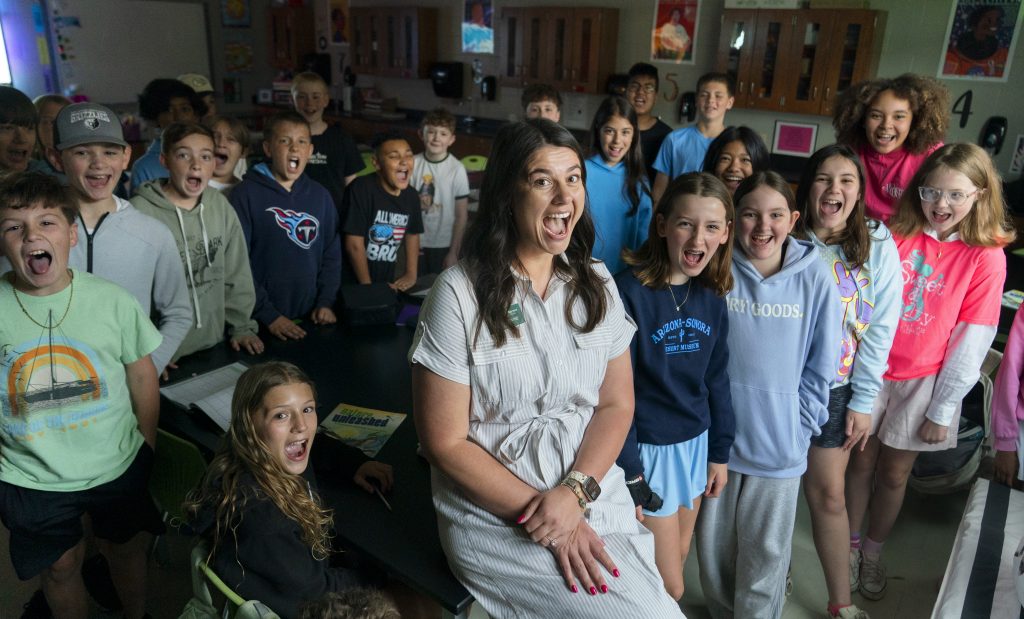
Photos by L.G. Patterson
3… 2… 1… blast off!
Students watch as their team’s balloon shoots to the ceiling, replicating a rocket ship. They add various weights to the balloon, determining if it will still reach its destination. All the while, they’re studying Newton’s third law of motion.
This is the classroom of Jennifer Payne, a nine-year veteran in the world of education, teaching science to sixth graders. The entirety of her career has been with Columbia Public Schools — first at Gentry, and then joining the inaugural staff at John Warner Middle School when it opened in 2020.

This spring, Payne was nominated for America’s Favorite Teacher, a national competition for educators that raises money for The Planetary Society. Though she was initially hesitant to throw her name in, she decided even if she lost, “it’s still for a great cause and whoever wins is a deserving teacher, and it’s exciting for them to have this kind of recognition.” Payne placed second in her group after making it to the Top 5 round.
Payne always had a passion for science, but did not initially foresee a life spent in front of a middle school classroom. Going to college at the University of Missouri, Payne had aspirations to work in health care. While volunteering for a health sciences organization, she walked into a classroom and instantly knew teaching was her calling. “(The students) were learning science, practicing scientific skills and being creative all at the same time,” she says. “That was something I was lacking in the medical field, so I changed my major and started my education journey.”
Curriculum standards established by the state of Missouri and Columbia Public Schools utilize science courses in middle school to give students a small “taste” of various topics. For Payne, that means first semester is all about physics and physical sciences, while second semester focuses on biology and ecology. “Hopefully by high school, (students) see a science they enjoy and then can maybe pursue,” Payne says.
Payne’s teaching philosophy begins with a simple desire to get students to think like a scientist. Beyond that, she wants them to remember that they actually enjoyed learning. “In middle school, everyone is trying to be cool, but I see the smiles and excitement,” she says. “If they can just remember the little sparks of joy they had when they learned something, that’ll be a win for me.”

Recently, Payne has noticed a trend to “make teaching boring again,” in an effort to bring formal education back, but she offers a different perspective. “It’s not like I’m tap dancing in the front of the room, but I am building engaging lessons,” she says. “The kids take the lesson I designed, learn from it and can then apply it to situations down the road.” Some of her activities include building paper roller coasters, pushing a car, looking at microbes from pond water and launching marshmallows.
In developing lesson plans, Payne asks herself what she needs students to know, and how to get them to collaborate, think critically and enjoy themselves. “Pulling it all together and helping them learn science along with life lessons is where my passion lies,” she says.
Even if her students don’t share her affection for parts of the cell, plate tectonics or outer space, Payne hopes they discover something they love as much as she loves teaching. “Whether that’s being a hairstylist, a photographer, an astrophysicist, a doctor or a lawyer, I hope they find joy in it,” she says. “There’s nothing I love more than coming to my job every day and I couldn’t imagine doing anything else, so I hope they see that and can find it for themselves.”
Entering her tenth year of teaching this fall, Payne has garnered a great deal of experience in being an educator. One thing she and reminds newer teachers of is that students are going to mess up, and it’s important to not take things too seriously. “I’m here to help them grow,” Payne says. “It doesn’t matter who’s on my roster, I’m going to help them learn science.”
Payne says her students would describe her as caffeinated (from a steady stream of coffee and Diet Coke), passionate about science and funny. Rarely is there a day where she walks into the school building in a bad mood. “I usually walk in and I’m like, ‘oh, today’s going to be a good day,’” she says.
Looking back on her years of teaching, Payne doesn’t see herself stopping any time soon. Her advice to her former self, on day one of being in the classroom, is to hang on. “The beginning of the year is like our Super Bowl; there’s so much to do and it’s stressful,” she says. “But I would tell myself on that first day that as soon as the kids get there, that’s what makes it worth it. Seeing their joy, seeing that they feel safe and comfortable enough to be themselves … it’s all worth it. And I love it even more now than I did back then.”
Teaching — especially in the years since the pandemic — hasn’t always earned the recognition it deserves. While many teachers have stepped away, educators like Payne are a big part of why students still look forward to coming to school each day.